


DA | EN | DE | FR | ES

Turkish Coffee Tradition, Technique, and Flavor

mad og drikke Kaffe
Turkish Coffee Title Image

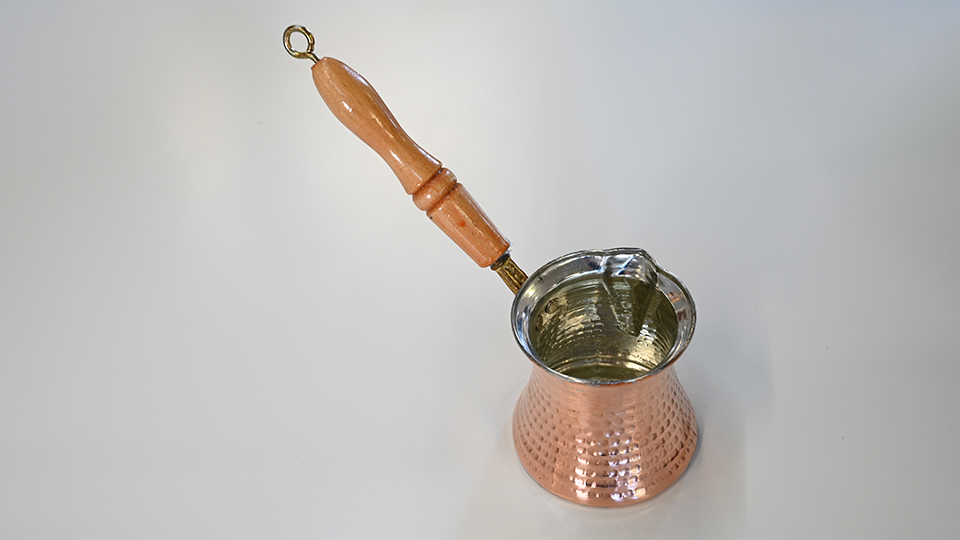
Turkish coffee is one of the world's oldest and most traditional brewing methods. It is characterized by its strong flavor, fine foam, and grounds at the bottom – and is brewed in a special small copper pot called a cezve (or ibrik).

The drink is enjoyed slowly and often in social or ceremonial settings, especially in Turkey, the Middle East, the Balkans, and North Africa. In 2013, Turkish coffee was included on UNESCO's list of intangible cultural heritage.

Equipment and ingredients

To brew authentic Turkish coffee, you will need the following:

  • Cezve: A small pot with a long handle, traditionally made of copper.
  • Very finely ground coffee: Often finer than espresso – almost like powder.
  • Cold water: Preferably filtered for better taste.
  • Sugar (optional): Added during brewing, not afterwards.
  • Spices (optional): Cardamom is a popular addition in many regions.

Note: Milk or cream is not used in Turkish coffee. It is drunk black.

How to brew Turkish coffee

This recipe is for one cup (approx. 100 ml), but you can easily multiply as needed.

Step-by-step:
  1. Pour 1 cup of cold water into the cezve.
  2. Add 1–2 teaspoons of very finely ground coffee per person.
  3. Add sugar, if desired:
    • No sugar: sade
    • A little sugar: az şekerli
    • Medium: orta şekerli
    • Sweetened: şekerli
  4. Stir the ingredients together thoroughly before turning on the heat.
  5. Heat slowly over low heat. Do not stir anymore!
  6. After a few minutes, the coffee will begin to foam up towards the edge – just before it boils, quickly remove it from the heat.
  7. Distribute the foam into the cup with a spoon. Place the cezve back on the heat and let it foam up one more time.
  8. Carefully pour the rest of the coffee into the cup without disturbing the grounds too much.

Serving and tradition

Turkish coffee is usually served in small porcelain cups without handles (fincan), preferably with a glass of cold water and perhaps a little lokum (Turkish delight).

The coffee is drunk slowly, savoring the taste and letting the grounds settle at the bottom. The cup is not emptied completely.

In some cultures, the grounds are read afterwards as a form of fortune-telling (coffee tasseography) – a cozy and spiritual tradition among friends and family.

Tips and variations

  • Foam is honor: A thick, stable foam is a sign of successful Turkish coffee.
  • No rush: Heat slowly – too high heat ruins the foam and the taste.
  • Cardamom: Add a pinch of ground cardamom for an authentic Arabic style.
  • Sugar balance: Sugar cannot be adjusted after brewing – decide before you start.

Conclusion

Turkish coffee is more than just a drink – it is an experience. A peaceful pause, a cultural ritual, and a craft where patience and precision are rewarded with intense flavor and beautiful foam. Try it yourself, and you will discover why this method has survived for centuries.



Similar articles

Introduction to Coffee
Kaffe
Introduction to Coffee
From Fruit to Brewed Cup
Black Tea
Te
Black Tea
The Classic with Body, Character, and Culture
Green Tea
Te
Green Tea
Freshness, Finesse, and Philosophy
Tea Bags
Te
Tea Bags
Convenience with Flavor

You might also like

Astrology
Det overnaturlige
Astrology
A Window to the Universe
World History According to KGM.DK
Historie
World History According to KGM.DK
From the Big Bang to Covid
Rosé Wine
Øl og Vin
Rosé Wine
Rosé Wine: From Summer Drink to Serious Wine Experience
USB Sticks
Hardware
USB Sticks
From Type-A to USB-C and Everything In Between