

DA | EN | DE | FR | ES

Plate Tectonics and Continents How Earth's Plates Move

naturvidenskab Geologi
Plate Tectonics and Continents Title Image

Introduction: Continents in Motion

Did you know that the place you are standing right now is actually moving? Even though we don't feel it, Earth's surface is slowly shifting around. The continents, as we know them today, have not always been where they are now. They have been joined together in gigantic supercontinents and have later drifted apart. This slow but powerful movement is called plate tectonics. In this article, we explain how the plates move, why the continents shift, and what dramatic consequences this has for the landscape and life on Earth.
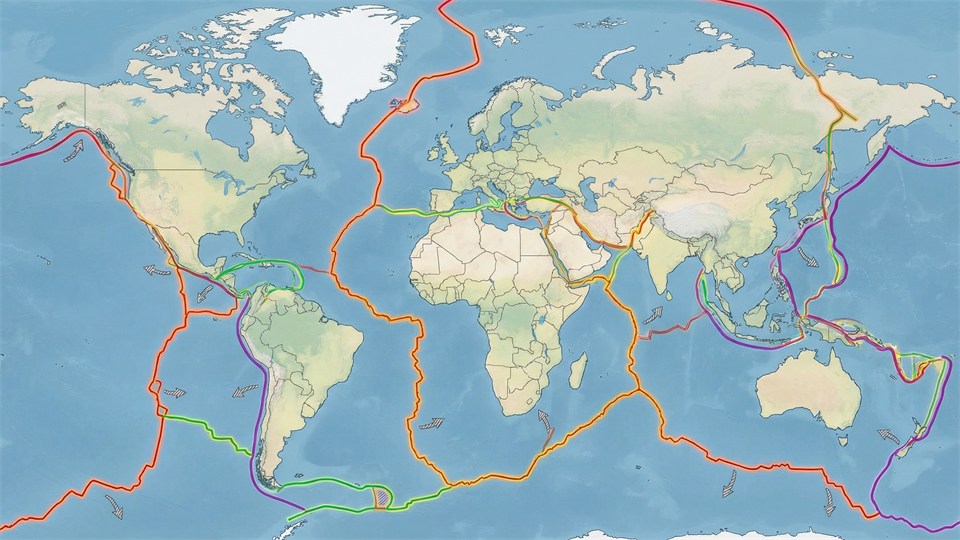
World map with tectonic plates and the positions of the continents

Plate Tectonics – Earth's Living Puzzle

Earth's outer shell, called the lithosphere, is not one continuous layer. It is divided into about 15 major and several minor tectonic plates. These plates consist of crust and the uppermost part of the mantle. Beneath the lithosphere lies the asthenosphere, a softer layer where material can flow slowly. Here, warm convection currents move, causing the plates above to glide around.

The tectonic plates typically move 2–10 centimeters per year – about as fast as your fingernails grow! That doesn't sound like much, but over millions of years, it can move entire continents across the globe.

Different Types of Plate Boundaries

Plate tectonics is about how these plates move in relation to each other. There are three main types of plate boundaries:

  • Convergent boundaries: Plates move toward each other. This can form mountains or cause one plate to dive beneath the other (subduction).
  • Divergent boundaries: Plates move away from each other. Here, new ocean floor and underwater mountain ranges often form.
  • Transform boundaries: The plates slide sideways past each other. This often creates powerful earthquakes.

The Dance of the Continents – from Pangaea to the Present

About 300 million years ago, almost all landmass was gathered in one giant supercontinent: Pangaea. Over time, the plates beneath Pangaea began to move, and the supercontinent broke up into smaller pieces. These pieces became the continents we know today.

If we look back millions of years, the continents have constantly changed position. For example, Greenland was once closer to Europe. South America and Africa also fit together like puzzle pieces. The traces can still be seen in rock formations, fossils, and mountain ranges across continents.
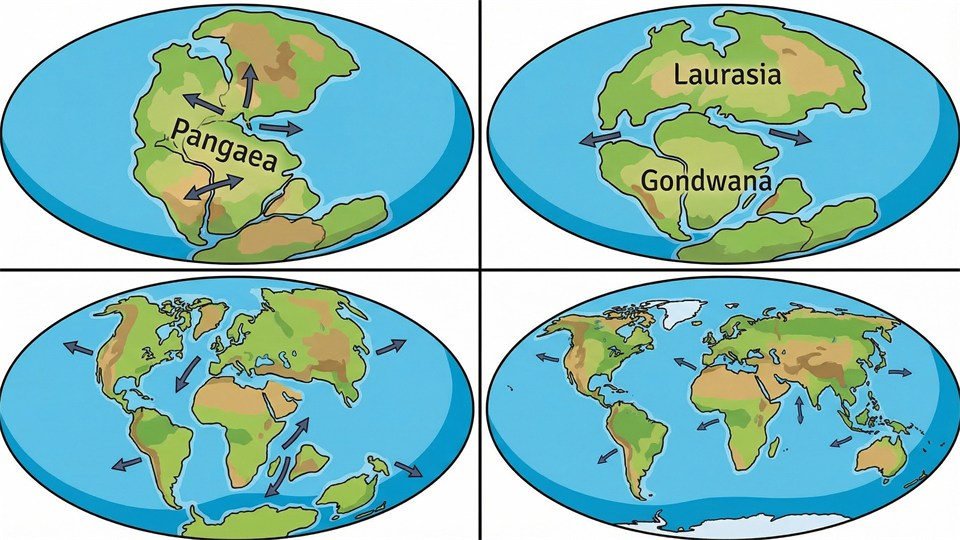
Illustration of Pangaea and the breakup of the continents over time

Examples of Continental Movements

  • The Atlantic Ocean is growing: Between the Americas and Europe/Africa lies a long underwater mountain range, the Mid-Atlantic Ridge. Here, the plates are pulling apart, and new ocean floor is formed – that's why the Atlantic Ocean is getting wider.
  • India's journey north: The Indian subcontinent has moved toward Asia at great speed (geologically speaking) and collided about 50 million years ago. This created the Himalayas, the world's highest mountain range.
  • The San Andreas Fault: In California, the Pacific Plate and the North American Plate slide past each other. That area therefore experiences many earthquakes, like the famous San Francisco quakes.

What Drives the Plates?

The movement of the plates is caused by heat energy from Earth's interior. Down in the mantle, there are convection currents – heat rises, cooler material sinks. It works a bit like a pot of soup being heated: the liquid circulates and pushes what is on the surface. The lithospheric plates lie like "islands" on top of the slowly flowing currents and are pushed, pulled, and dragged along.

At the edges of the plates, material can melt and form magma. When magma pushes up through cracks, new ocean floor or volcanoes are formed. At the same time, heavy, cold plates can sink down into the mantle (subduction) and pull the rest of the plate with them.

Consequences of Plate Tectonics

Plate tectonics is not just something that happens slowly and quietly beneath the surface. It has dramatic and noticeable consequences for both the landscape and life on Earth. Here are some of the most important:
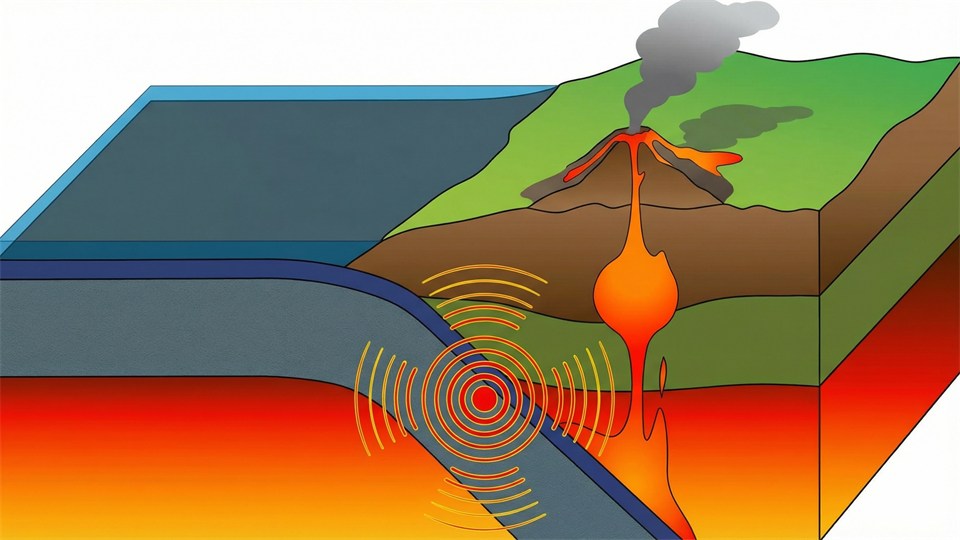
  • Mountain ranges: When plates collide, the crust can fold and be pushed upward to form mountains – like the Himalayas and the Alps.
  • Earthquakes: When plates suddenly shift, enormous amounts of energy are released as tremors. This can destroy cities and change landscapes in seconds.
  • Volcanic eruptions: Where plates move apart or where one dives beneath another, magma can reach the surface and create volcanoes.
  • Ocean floor formation and oceans: New oceans are formed when plates pull apart, as is happening in the Atlantic Ocean.
  • The evolution of life: The movement of the continents has changed climate, ocean currents, and ecosystems and has had a major impact on how life has evolved on Earth.
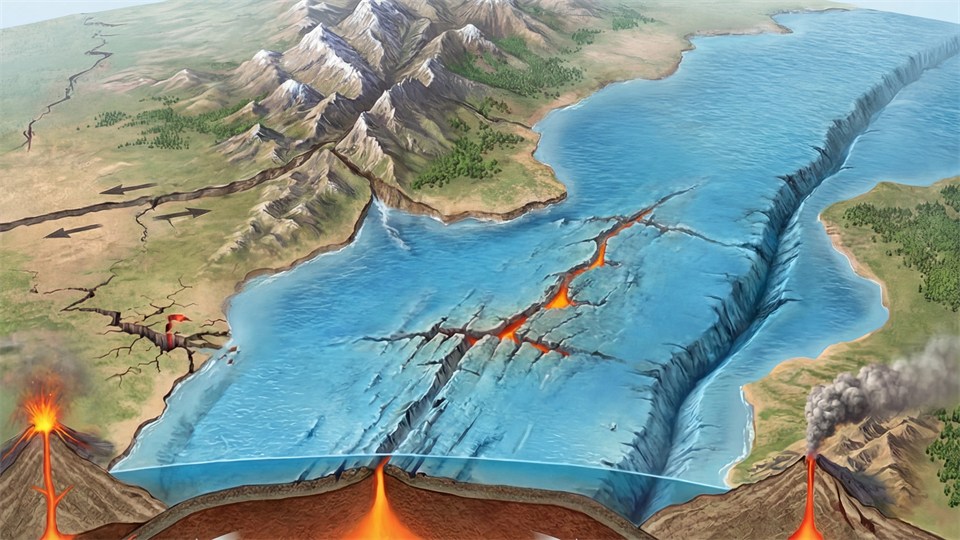
Illustration of a plate boundary with volcano and earthquake

How We Know the Plates Are Moving

Although plate tectonics happens very slowly, scientists have found several ways to prove and measure the movement of the plates:

  • GPS measurements: Satellites can accurately measure how specific points on land move year by year.
  • Rock and fossil evidence: Similar rocks and fossils are found on continents that are now far apart but were once connected.
  • Magnetic stripes on the ocean floor: When new ocean floor forms at underwater ridges, the minerals "freeze" Earth's magnetic field into themselves. These stripes lie symmetrically on both sides of the ridge and show how the ocean floor spreads outward.
  • Earthquakes and volcanoes: Most of the world's earthquakes and volcanoes are located along plate boundaries.

The Importance of Plate Tectonics for the Future

The plates will continue to move for millions of years to come. Perhaps the continents will once again gather into a new supercontinent far in the future. This movement will continue to shape landscapes, ocean currents, and climate – and challenge humanity's ability to adapt.

Plate tectonics not only explains why Earth looks the way it does. It also helps us understand natural disasters, find resources, and protect ourselves from geological risks. Understanding plate tectonics is therefore the key to understanding our planet and its dynamic history.

Conclusion

Plate tectonics is Earth's slow but powerful engine. It moves continents, builds mountains, opens oceans, and causes earthquakes and volcanic eruptions. Even though the movements are slow, they have shaped all life on Earth over time. When we look at the world map, it is only a snapshot of a constantly changing planet.

Similar articles

What is Geology?
Geologi
What is Geology?
Basics of Earth's Structure and the Importance of Geology
Erosion: Wind, Water, and Ice
Landskabsdannelse
Erosion: Wind, Water, and Ice
Nature's forces shape our landscape
Rivers and Deltas: Nature's Shapers
Landskabsdannelse
Rivers and Deltas: Nature's Shapers
How rivers and deltas shape the landscape
Earth's Inner Layers
Geologi
Earth's Inner Layers
Core, Mantle, and Crust Explained for Beginners

You might also like

Astrology
Det overnaturlige
Astrology
A Window to the Universe
World History According to KGM.DK
Historie
World History According to KGM.DK
From the Big Bang to Covid
Rosé Wine
Øl og Vin
Rosé Wine
Rosé Wine: From Summer Drink to Serious Wine Experience
USB Sticks
Hardware
USB Sticks
From Type-A to USB-C and Everything In Between