Boron (B) is a chemical element with atomic number 5. It is a metalloid and is placed in group 13 of the periodic table. Boron has unique chemical properties and plays an important role in both industry and biology.
1. Introduction to boron
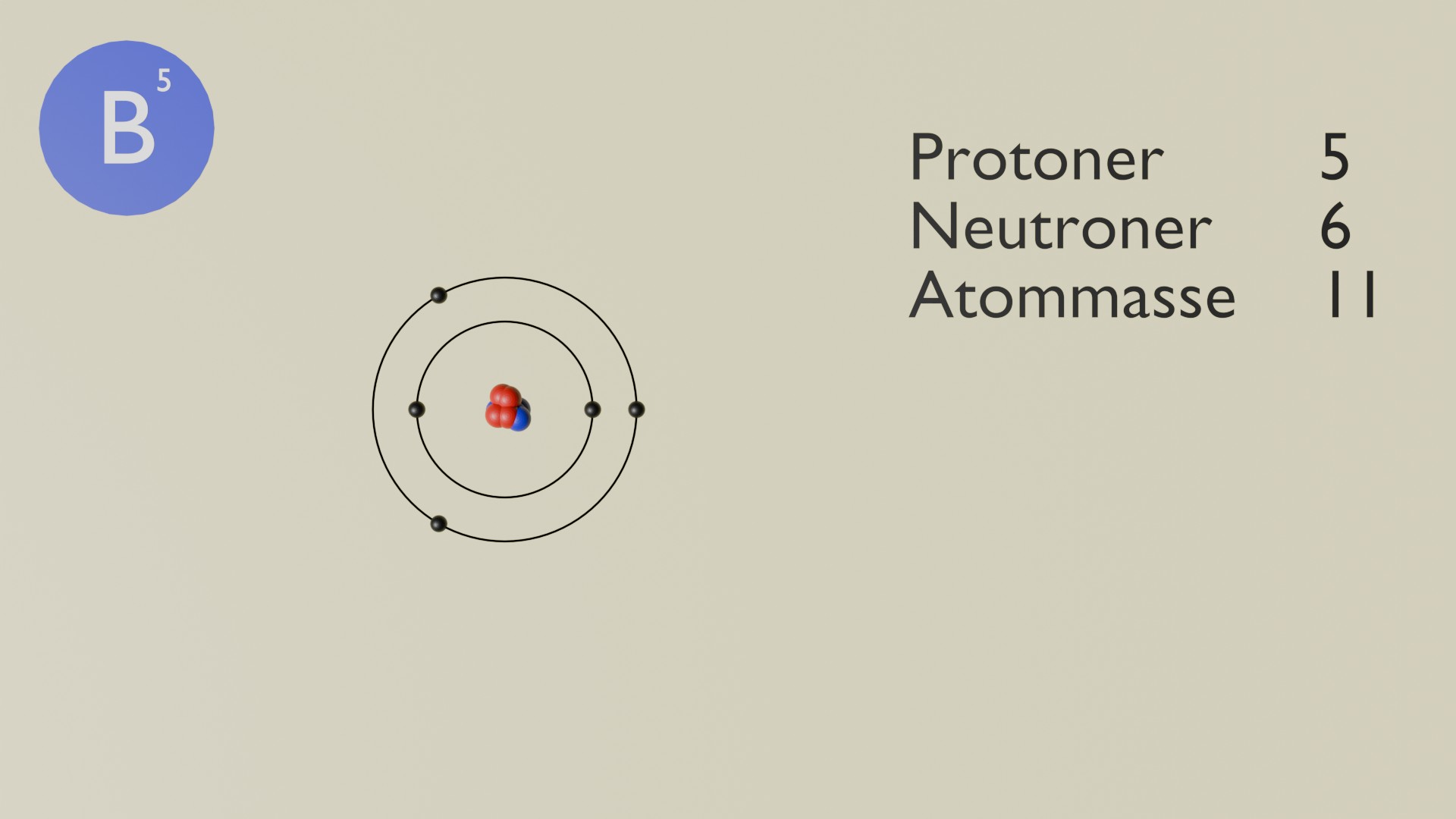
Boron has 5 protons, typically 6 neutrons, and 5 electrons. It does not occur freely in nature, but appears as compounds in minerals such as borax and kernite. Boron is considered a transitional element between metals and non-metals and has both metallic and non-metallic properties.
2. Physical and chemical properties
Pure boron is a black-brown, hard, but brittle metalloid. It is a poor conductor of electricity at room temperature, but conductivity increases with heat. Boron forms complex compounds and has a high melting point (2,076 °C).
Boron has three valence electrons and typically forms covalent bonds. It plays an important role in the formation of heat-resistant materials and strong ceramic compounds.
3. Isotopes of boron
Boron occurs naturally in two stable isotopes:
- Boron-10 (¹⁰B): 5 protons and 5 neutrons (approx. 20%)
- Boron-11 (¹¹B): 5 protons and 6 neutrons (approx. 80%)
Boron-10 is used in nuclear applications because it has a great ability to capture neutrons.
4. Industrial applications
Boron is used in a wide range of industrial and technological fields:
| Application | Description |
| Glass and ceramics | Added to make materials stronger and more heat-resistant – e.g. in Pyrex glass. |
| Fertilizer and agriculture | Trace element in plants; boron deficiency can lead to stunted growth. |
| Semiconductors and electronics | Used as a dopant in the manufacture of semiconductors (boron-silicon). |
| Neutron control | Boron-10 is used in nuclear reactors as a neutron-absorbing material. |
5. Occurrence and biological significance
Boron is found in nature as salts and minerals, especially in dry lake areas and salt deposits. The largest boron deposits are found in the USA, Turkey, and Argentina.
Boron is important in small amounts for plant growth and for bone development in humans, but larger doses can be toxic. In industry, dust and fumes must be handled with care.