

DA | EN | DE | FR | ES

Offensive Play From running plays to passing plays

sport Amerikansk fodbold
Offensive Play Title Image

This article provides a practical overview of offensive play in American football. We start with purpose and concepts, go in-depth with running and passing plays, look at option concepts, pre-snap formations and motion, blocking principles, and finish with advanced pass concepts as well as examples of how coaches combine everything into a gameplan.

Table of Contents

Offense – purpose, language, and playcalling

Offensive football is about moving the ball efficiently, creating first downs, and scoring points. Plays are called via a playcall, which specifies formation, personnel, protection, and the actual concepts (run or pass). Modern offenses often use packaged plays, where multiple options are built in: the QB can change the play (audible), change protection, or read a specific defender (key) after the snap.

Running plays (run)

The run is the foundation for many offenses: they control the clock, keep the defense honest, and make play-action dangerous. The two main schools are zone and man/gap. Zone focuses on blocking areas and creating cutback lanes; man/gap creates a specific hole via pulling blockers and double teams.

  • Inside Zone: Run up the middle; RB reads first down lineman past the center and cuts up (cutback, bang, or bounce).
  • Outside Zone / Stretch: Horizontal flow; RB aims for the edge and reads the shoulder of the contain/edge.
  • Power: Classic gap run with down-blocks and a pulling guard leading into the hole (typically C-gap).
  • Counter: Backside flow from the O-line and pull from the backside guard/tackle – lures the defense off before attacking.
  • Trap: Quick inside attack where a pulling guard “traps” a defensive tackle.
  • Sweep / Toss: Perimeter run with lead blockers in space; good against heavy inside fronts.
  • Draw: The line sells pass, but the RB gets the ball – punishes aggressive pass rush.

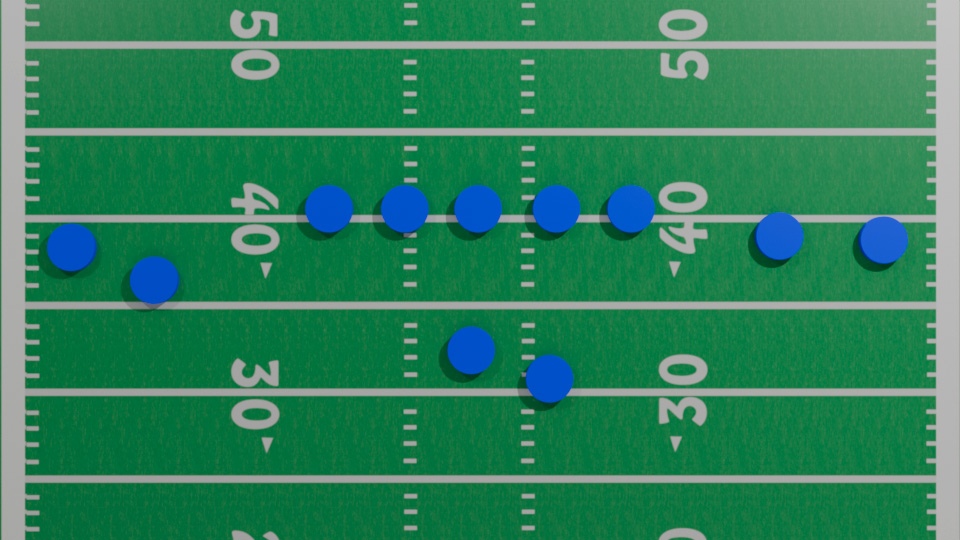
Inside Zone – reads

Zone step RB read

Power – pull and kick-out

Pull Kick-out

Passing plays (pass)

Passing plays range from quick quick game (3-step) to deep concepts (5-/7-step). The goal is to attack specific zones in the defense and create mismatches. The QB typically reads high-low, progression, or a specific defender.

  • Quick game: Slant, hitch, stick, speed-out – timing, rhythm, and yards after catch.
  • Intermediate: Dagger (dig + clear), curl-flat, spacing, drive – attacks hook/curl.
  • Deep: Post, corner, deep over, four verts – requires solid protection and play-action threat.
  • Screens: RB/WR/TE screens, tunnel/bubble – punishes blitz and soft zone.
  • Play-action: Sells run to open space behind LBs; especially effective from 12 personnel.

Option and RPO

In option plays, a defender is left unblocked and forced to choose – the QB reads him and decides. In RPO (Run-Pass Option) a run block is combined with a quick pass option. If the box is too heavy, the QB throws quickly outside; if it’s light, the ball is given to the RB. Read-option lets the QB keep the ball if the edge crashes.

  • Zone read: QB reads backside edge; give/keep.
  • Triple option: Give/keep/pitch depending on two keys.
  • RPO (stick/bubble/glance): Quick combination against linebacker fit or soft leverage.

6) RPO – glide/quick out of zone look

Give Bubble

Formations & pre‑snap motion

Formation determines the starting point: personnel (e.g. 11 = 1 RB, 1 TE), splits, stacks/bunch, and alignments. Pre-snap motion is used to reveal man vs. zone, get favorable matchups, and change the strength side. Shifts require everyone to be set for a moment before the snap.

  • 11 personnel: Balanced standard; three WRs create horizontal space.
  • 12 personnel: Two TEs – physical run and heavy play-action.
  • Spread/Empty: Four-five WRs – forces defense into nickel/dime.
  • Bunch/Stack: Tight WR clusters that create natural picks and free release.
  • Pistol/Shotgun: QB deeper for better vision; pistol keeps RB central for both ways.

Blocking schemes (zone vs. man/gap)

In zone the line works laterally and doubles up to the 2nd level; RB reads holes. In man/gap a hole is created via down-blocks, pull, and kick-out. The choice matches the roster and the opponent’s fronts. Protections in pass (slide/half-slide/man) determine who is responsible for extra rushers (rule: hot or site-adjust on WR).

Advanced pass concepts

  • Mesh: Two crossing drags create a natural rub against man; back/over as 3rd read.
  • Smash: Hitch/corner high-low against Cover 2 corner.
  • Flood: Three-on-one side at deep/mid/short; effective against Cover 3.
  • Y-Cross: Cross over the middle with deep clear – Air Raid classic.
  • Four Verticals: Stretches two high safeties vertically; read the seam.
  • Levels/Drive: Horizontal routes at multiple depths – easy progression.

Mesh – cross against man

Mesh point Over

Flood – three-on-one side

Out Corner Go

Smash – high-low against Cover 2

Hitch Corner Cover 2-corner read high-low

From concepts to gameplan

A good gameplan builds on your own strengths and the opponent's weaknesses. Typically, the first 10–15 plays are scripted to test reactions. On 3rd & short, power/counter and quick game can dominate; on 3rd & long, screens, draws, and flood variants are planned against Cover 3. In the red zone near the goal, condensed splits, rub concepts, and heavier personnel (12/13) are used together with play-action.

Similar articles

American Football
Amerikansk fodbold
American Football
Rules, Positions, and Game Structure
Defensive Formations
Amerikansk fodbold
Defensive Formations
Defensive formations and strategies in American football
American Football in Denmark
Amerikansk fodbold
American Football in Denmark
History, Present, and Future
Handball
Håndbold
Handball
Introduction to rules, courts, and equipment.

You might also like

Astrology
Det overnaturlige
Astrology
A Window to the Universe
World History According to KGM.DK
Historie
World History According to KGM.DK
From the Big Bang to Covid
Rosé Wine
Øl og Vin
Rosé Wine
Rosé Wine: From Summer Drink to Serious Wine Experience
USB Sticks
Hardware
USB Sticks
From Type-A to USB-C and Everything In Between