
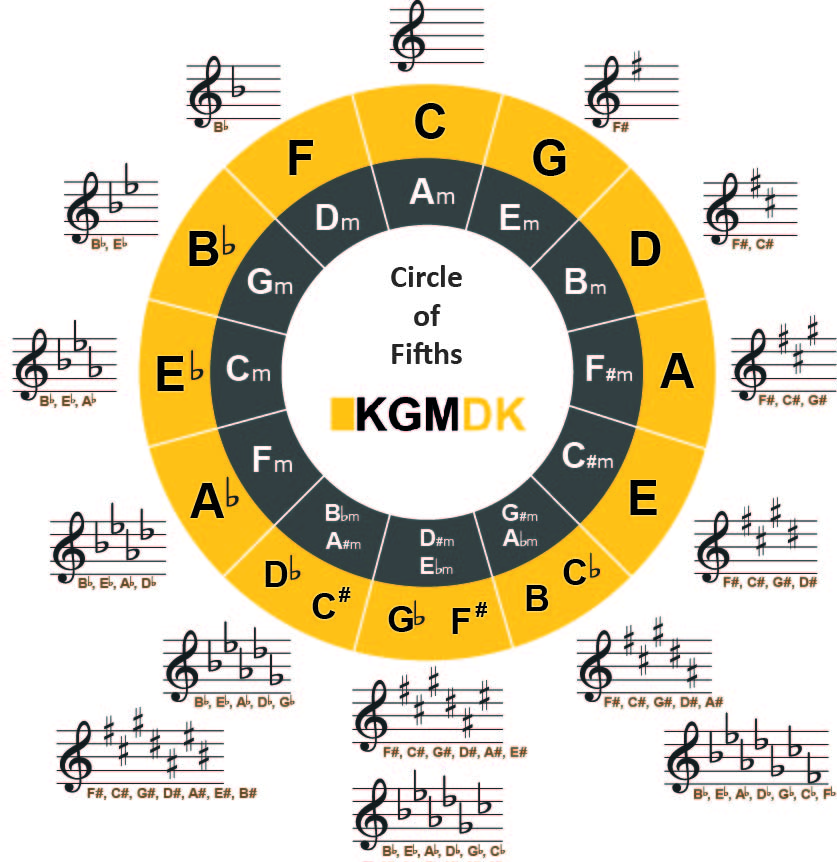


The circle of fifths is one of the most important tools in music theory and is used to understand the relationship between keys, accidentals, and chords. It provides a visual overview of how the 12 different keys are connected and how you can easily move between them.
The circle of fifths is constructed as a circle, where each step clockwise corresponds to a perfect fifth up, while each step counterclockwise corresponds to a perfect fifth down. This structure makes it possible to organize the keys in a logical and clear way.
The center of the circle of fifths is the key of C major, which has no accidentals. From here, you move around the circle:
Each time you move one step clockwise, one sharp (#) is added to the key. If you go counterclockwise, one flat (♭) is added. This makes the circle of fifths an effective tool for quickly identifying the number of accidentals in a given key.
For example, G major has one sharp (F#), D major has two (F# and C#), and A major has three. In the same way, F major has one flat (B♭), while B♭ major has two flats.
The circle of fifths contains both major and minor keys. Each major key has a so-called relative minor key, which shares the same accidentals.
The relative minor key is always a minor third (three semitones) below the major key. Examples:
Although these keys use the same notes, they are experienced very differently. Major is often associated with a bright and stable sound, while minor is typically perceived as darker and more emotional.
The circle of fifths also makes it easy to remember the order of accidentals.
Sharps (#):
F → C → G → D → A → E → B
Flats (♭):
B → E → A → D → G → C → F
This order is not random – it follows the movement in the circle of fifths. When you learn these patterns, it becomes much easier to read sheet music and understand keys.
One of the most practical uses of the circle of fifths is to find out which key a piece of music is in. By looking at the number of sharps or flats in the staff, you can quickly place the key in the circle of fifths.
The circle of fifths is often used to understand chord progressions. Chords that are close to each other in the circle typically sound good together.
A classic progression is:
II – V – I
In C major, this corresponds to:
Dm – G – C
These chords are next to each other in the circle of fifths, which creates a natural and pleasant movement.
When you change key in a piece of music, it is called modulation. The circle of fifths helps to find keys that are close to each other and therefore provide a smooth transition.
If you are playing in D major, the nearest keys will be:
These keys share many notes and therefore feel natural to switch between.
The circle of fifths is a valuable tool for both composers and musicians who improvise. It helps to:
In the circle of fifths, some keys meet that sound the same but are written differently. These are called enharmonic keys.
Examples:
Although they consist of the same notes on a piano, different terms are used depending on the musical context.
A visual representation makes the circle of fifths much easier to understand. In the diagram below, you can see how the keys are arranged in a circle.
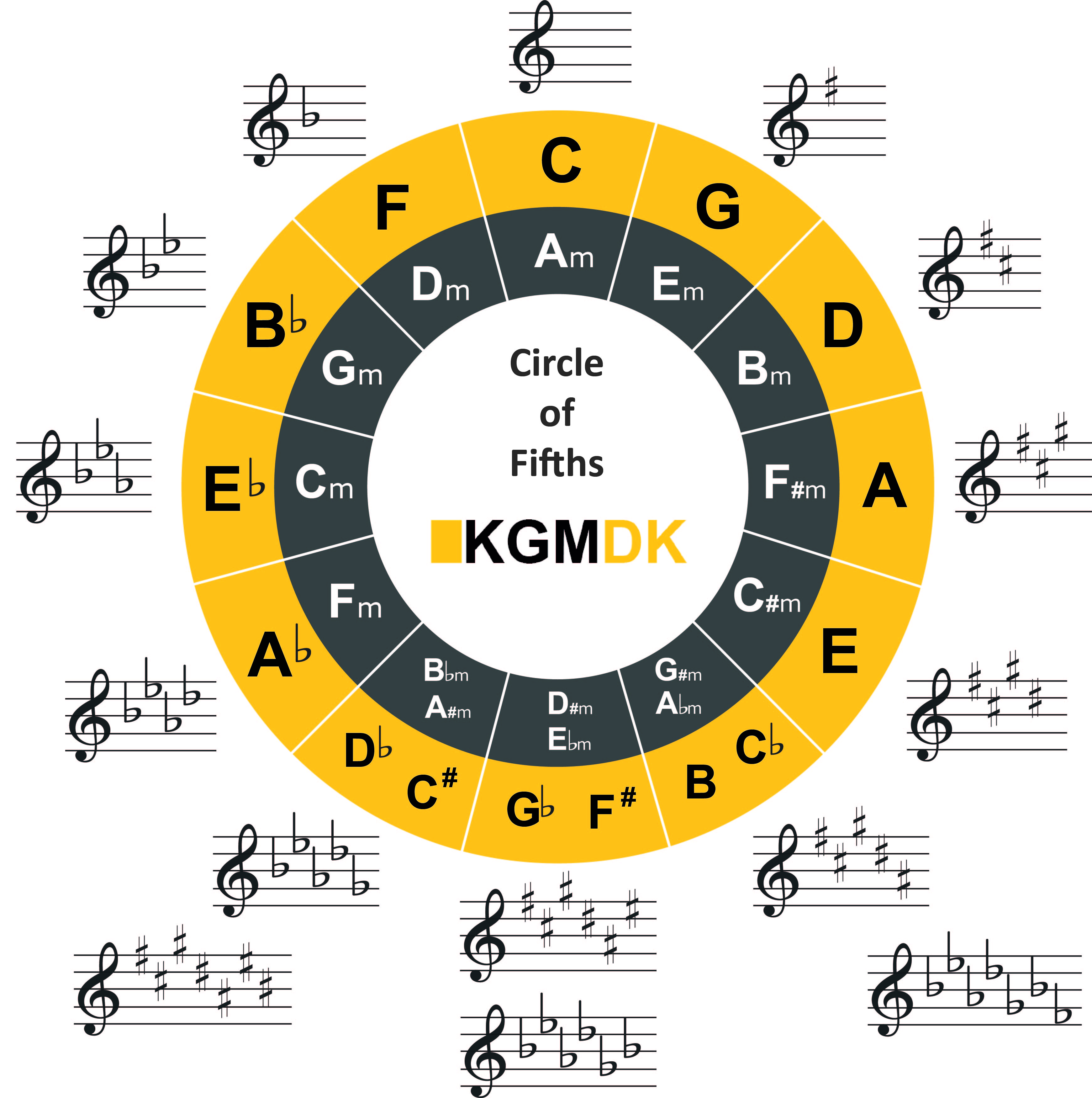
In the center you will find the major keys, while the corresponding minor keys are often shown either inside or outside the circle. Notice how the accidentals gradually change as you move around.
For beginners, the circle of fifths may seem complex, but it quickly becomes a useful tool with a little practice. Here are some tips:
The circle of fifths is a key to understanding the structure of music. It shows:
Once you master the circle of fifths, you gain a strong foundation for playing, composing, and analyzing music. It is a tool used by both beginners and professional musicians.