

A major scale consists of seven notes arranged in a specific pattern of whole and half steps. The formula for a major scale is:
Whole – Whole – Half – Whole – Whole – Whole – Half
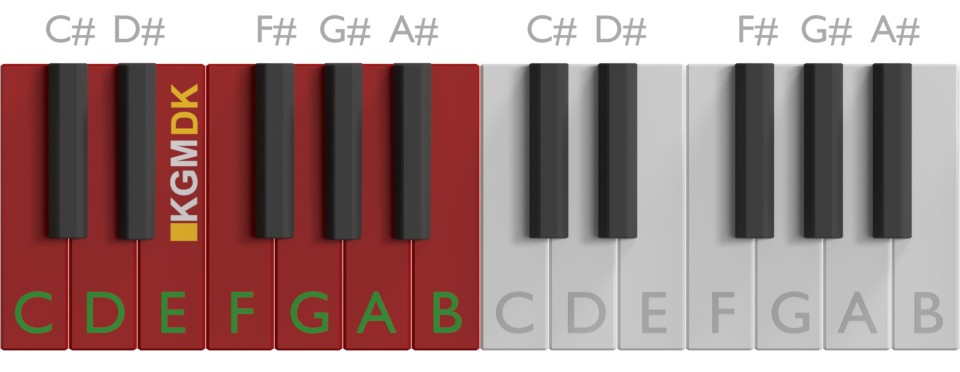
If you start on the note C and follow this formula, you get: C – D – E – F – G – A – B – C. Here there are no accidentals, which makes C Major the most “pure” and often the first scale you learn.
| Scale | 1 | 2 | 3 | 4 | 5 | 6 | 7 | Accidentals |
|---|---|---|---|---|---|---|---|---|
| C-Dur (C Major) | C | D | E | F | G | A | B | 0 |
| G-Dur (G Major) | G | A | B | C | D | E | F# | 1: F# |
| D-Dur (D Major) | D | E | F# | G | A | B | C# | 2: F#,C# |
| A-Dur (A Major) | A | B | C# | D | E | F# | G# | 3: F#,C#,G# |
| E-Dur (E Major) | E | F# | G# | A | B | C# | D# | 4: F#,C#,G#,D# |
| H-Dur (B Major) | B | C# | D# | E | F# | G# | A# | 5: F#,C#,G#,D#,A# |
| fis-Dur (F# Major) | F# | G# | A# | B | C# | D# | E# | 6: F#,C#,G#,D#,A#,E# |
| Ges-Dur (G♭ Major) | G♭ | A♭ | B♭ | C♭ | D♭ | E♭ | F | 6:G♭,A♭,B♭,C♭,D♭,E♭ |
| Des-Dur (D♭ Major) | D♭ | E♭ | F | G♭ | A♭ | B♭ | C | 5:G♭,A♭,B♭,D♭,E♭ |
| As-Dur (A♭ Major) | A♭ | B♭ | C | D♭ | E♭ | F | G | 4:A♭,B♭,D♭,E♭ |
| Es-Dur (E♭ Major) | E♭ | F | G | A♭ | B♭ | C | D | 3:A♭,B♭,E♭ |
| B-Dur (B♭ Major) | B♭ | C | D | E♭ | F | G | A | 2:B♭,E♭ |
| F-Dur (F Major) | F | G | A | B♭ | C | D | E | 2:B♭ |
C Major is the starting point for much music theory because it has no accidentals. It is often used for beginners, as all the keys on the piano are white. Sonically, it is bright and neutral. Many simple melodies, children's songs, and folk tunes are in C Major.
G Major has one sharp: F#. It is widely used in folk music, pop, and guitar playing, as the open strings on the guitar fit well with this key. The sound character is warm and bright, and it is often used for cheerful melodies.
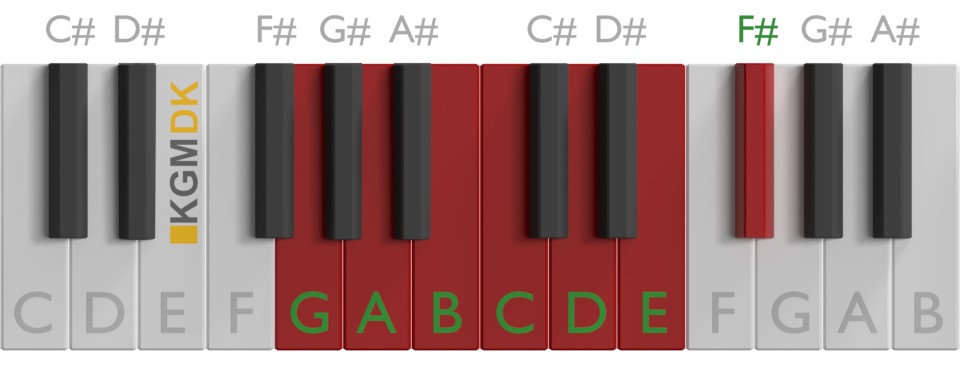
D Major has two sharps: F# and C#. It is popular in classical music, folk music, and orchestral works. Violins sound especially good in D Major, as the open strings fit perfectly. It has a clear and brilliant sound.
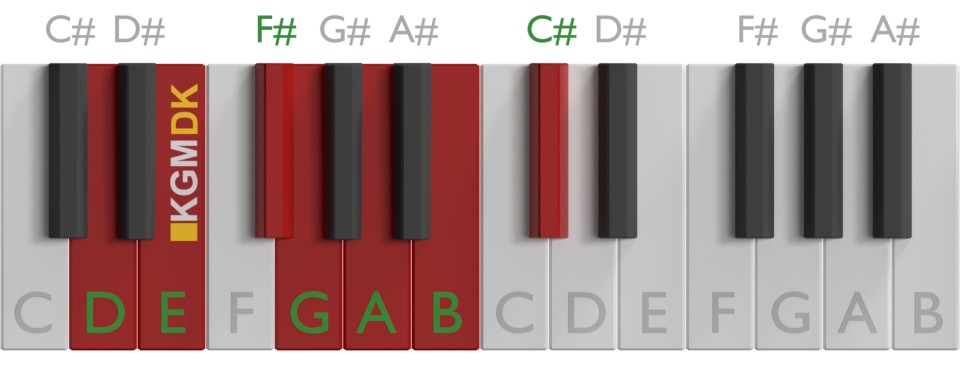
A Major has three sharps: F#, C#, and G#. It is often used in rock, pop, and country. On guitar, A Major feels natural to play. In terms of sound, it is energetic and open.
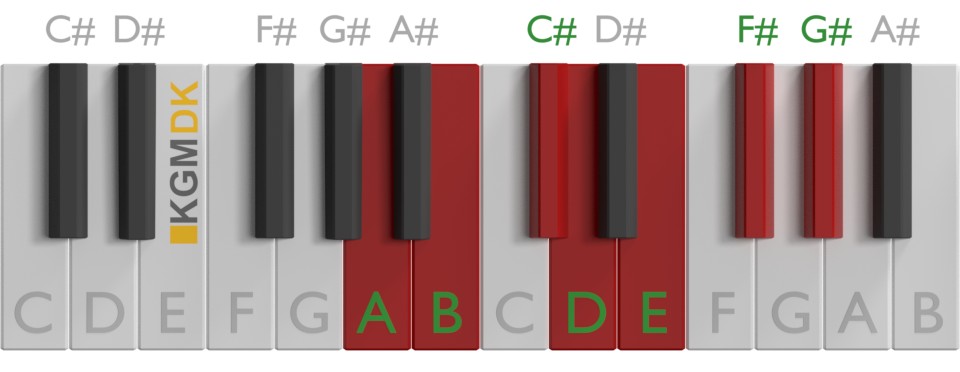
E Major has four sharps: F#, C#, G#, and D#. It is widely used in guitar-based music, as the open strings in E fit perfectly. It has a bright, strong, and powerful sound, suitable for energetic songs.
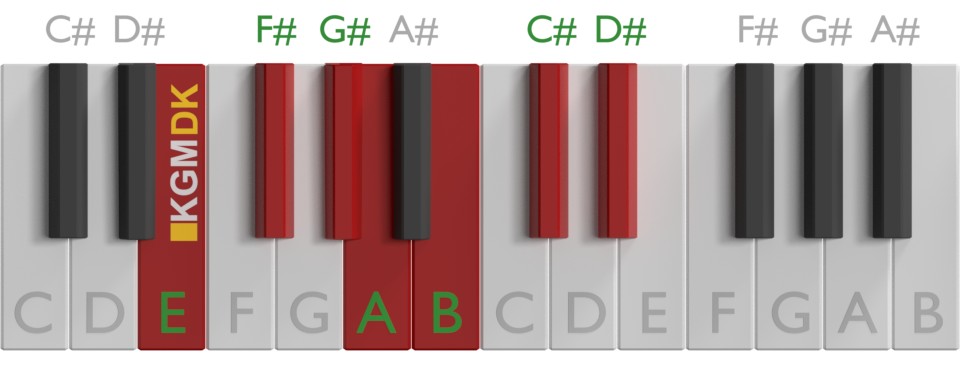
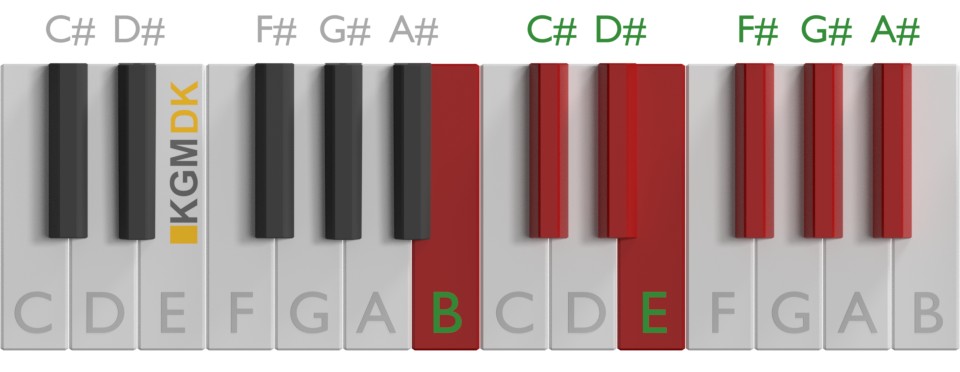
B Major has five sharps: F#, C#, G#, D#, and A#. It is less used in pop and rock, but often appears in classical works and jazz. It can be technically challenging on certain instruments.
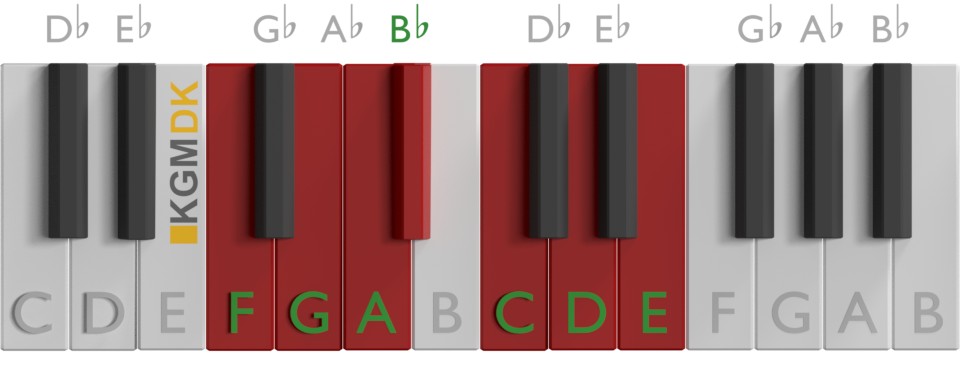
F Major has one flat: Bb. It is widely used in choral and wind music. It has a soft and warm sound and is easy to sing in. Many ballads and calmer pieces use F Major.
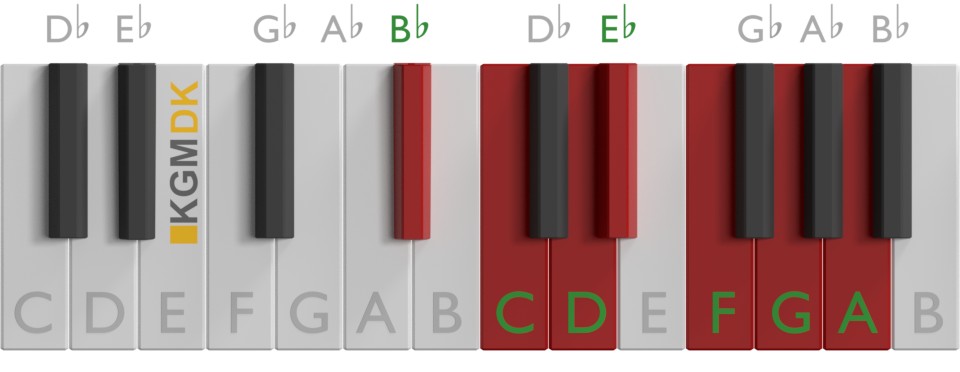
B♭ Major has two flats: Bb and Eb. It is very common in jazz, brass bands, and orchestral music, especially for wind instruments such as trumpet and clarinet. In terms of sound, it is full and round.
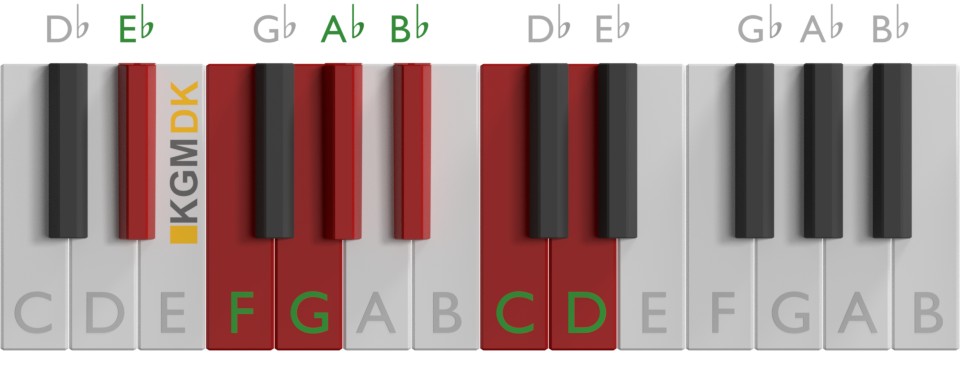
E♭ Major has three flats: Bb, Eb, and Ab. It is often used in jazz, romantic classical works, and wind ensembles. It has a warm and calm sound.
A♭ Major has four flats: Bb, Eb, Ab, and Db. It is often used in romantic compositions and ballads. In terms of sound, it feels soft and full.
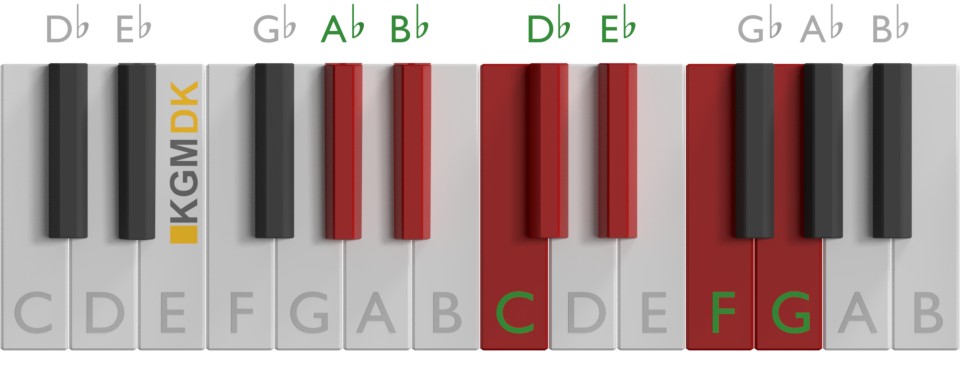
D♭ Major has five flats: Bb, Eb, Ab, Db, and Gb. It appears in romantic works and gives a very soft and rich tone color. Can be technically demanding for certain instruments.
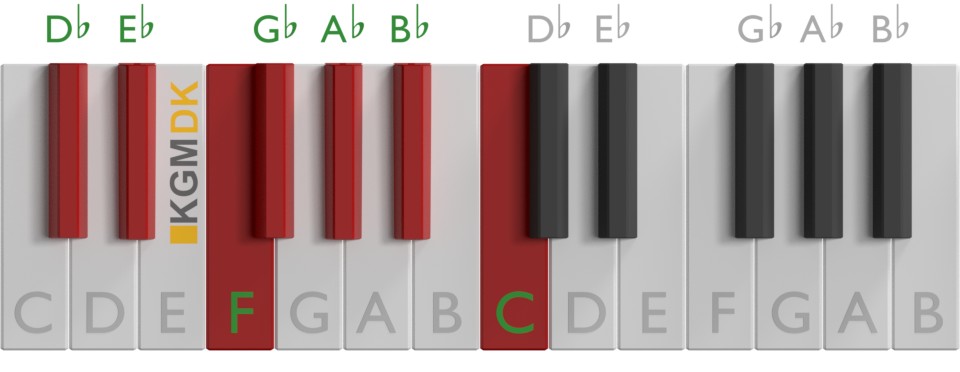
F# Major has six sharps: F#, C#, G#, D#, A#, and E#. It is used less frequently, but can provide a brilliant and intense sound. Often used on guitar with capo or in orchestral music for strings.
G♭ Major is enharmonic to F# Major (same notes, written differently). It has six flats: Gb, Ab, Bb, Cb, Db, Eb. It is often used in piano music, as it fits naturally to the black keys.
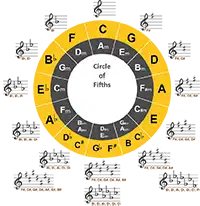
The circle of fifths is a tool in music theory that shows the relationship between keys and their accidentals. It works as a round “map” of major and minor keys, where you move in intervals of fifths (five notes up or down).
The circle of fifths is used to find related keys, modulate between them, and understand chord progressions. It also shows that many keys are enharmonic, i.e., they sound the same but are written differently (e.g., F# Major and G♭ Major).